Thursday, October 16, 2014

Beauty in the city

If you're like me, you have a hard time dropping $15 to go wander the Botanic Gardens when a few extra minutes of driving can put you in the middle of equally beautiful wilderness.


Case in point #1

#2

And #3--all less than 90 min from my house

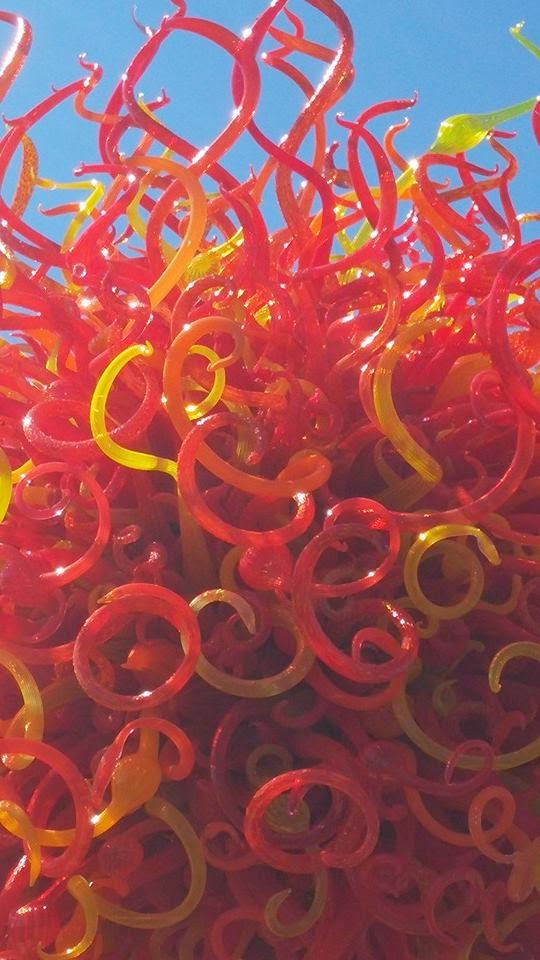
However, I have always been a fan of what I've seen of Dale Chihuly, beginning with the massive entryway sculpture at the Joslyn in Omaha. The colors and shapes are arresting, especially when you consider it's all blown glass.

Inside and Out. Photo courtesy of the Joslyn. Stunning, right?

And we just happen to have a huge collection of his outdoor work at the Botanic Gardens right now. I was chatting it over with a friend of mine, who lamented that it seems pointless to go look at all these sculptures when even more beautiful creations are all around in the flora that normally inhabits the gardens. It's true; sorry, Dale, but you can't beat the Master at His own game. Never the less, I think it is absolutely worth a visit for a few reasons.

1) Gets you outside in the beautiful Colorado fall.
2) Gives you a reason to drop the money to take in the best of creation (especially the alpine collection, the birds and bees walk, and the rose garden), and because you spent the money, you might actually stop to enjoy it, instead of passing it by like we do every day.
3) Tons of beautiful sculptures will make you feel cultured without feeling cooped up in a museum.

#nofilter (I don't really know what that means, but I've always wanted to write it)


So if you haven't yet seen the exhibit, it's worth it. And if you'd rather instead head up to the mountains to see the changing fall colors, fine by me. Bottom line, there's a lot of beauty out there to be seen. Get off the computer and go see it!

Tuesday, October 14, 2014

Comments on the Synod "Relatio"

The interim summary of discussions from the Synod on the Family has been released. I'm not presuming to have a firm grasp on all the nuances, or a definitive critique, but I thought I would put forward some general points and my commentary. (Disclaimer: this is long and academic, but still shorter than reading the full document, although you should do that too)

The document divides itself into 3 parts, saying that the Church must first 1) listen to the challenges for the family in the modern world, then 2) look to Christ for His revelation about the beauty and truth of the family, then 3) discuss how these two converge.

In the first part, the document examines a (non-exhaustive) list of the challenges that the Christian family faces today, cognizant of the cultural differences and economic barriers: polygamy, taxation, violence, single-parent homes, mixed-religion couples, and the emotional desires for intimacy and growth. From a pastoral standpoint, addressing these challenges "requires that the doctrine of the faith, the basic content of which should be made increasingly better known, be proposed alongside with mercy." (11)

At the beginning of part two, we encounter what I think is the major "controversy", if you will, that the media has latched onto. The document sites this "law of gradualness" referenced in JPII's Famililaris Consortio and says that this means "interpreting the nuptial covenant in terms of continuity and novelty"(13). I think many people see this as a concession that the Church needs to re-interpret things in light of today's culture. I wonder if this is even the intent of some of the bishops, despite the fact that right after this, we are reminded of Jesus' caution that while Moses gave a law of divorce because of the hardness of the Israelites' hearts, "from the beginning it was not so" (14, cf Mt 19:8). Allowances for a practice of sin are not the fullness of God's plan for us, and should be no more than a temporary stop-gap while we continue to convert those hard hearts, not a concession to the culture. This is in fact what JPII meant when he first mentioned the "law of gradualness" in his writings on the Christian family in the modern world:
[Man] knows, loves, and accomplishes moral good by stages of growth..."And so what is known as 'the law of gradualness' or step-by-step advance cannot be identified with 'gradualness of the law,' as if there were different degrees or forms of precept in God's law for different individuals and situations"... It will be easier for married people to make progress if, with respect for the Church's teaching and with trust in the grace of Christ, and with the help and support of the pastors of souls and the entire ecclesial community, they are able to discover and experience the liberating and inspiring value of the authentic love that is offered by the Gospel and set before us by the Lord's commandment.(Fam. Cons. 34, emphasis mine)
 In other words, we convert in stages, by teaching authentic love and allowing people to progress towards acceptance of the Gospel gradually, not with judgement, but with understanding. It certainly does not mean that gradually we change the Gospel to accommodate the culture's whims and individualistic hedonism. 

The current document reaffirms this further along in part two: that in difficult circumstances, "the value and consistency of natural marriage must first be emphasized"(18). Somehow the media ignores this (are you surprised?) and jumps straight to the next point. Namely, that "with regard to cohabitation, civil marriages and divorced and remarried persons,...the Church turns respectfully to those who participate in her life in an incomplete and imperfect way, appreciating the positive values they contain rather than their limitations and shortcomings"(20). Many people will see part two as a confirmation that cohabitation and civil unions are morally good, and think that the Church is finally admitting that Her teachings were behind the times. But there is a far cry from "accepting the reality" of a situation, and condoning it as morally permissible or the greatest good. Taken in context, it's clear that the Church recognizes that incomplete participation in the sacramental fullness of marriage still has some merit, insofar as it embraces the family as necessary and fruitful, but that we hope for all people to progress towards something better.

Part three starts with an exhortation to families and couples to participate in the joyful evangelization of the culture and announcement of the good news of the Church's teaching on the family. The document mentions the importance of helping young couples adequately prepare for marriage and navigate the difficult early years of marriage with support from experienced couples and the parish.

The section on separated and divorced couples starts out really beautifully, recognizing the suffering of these men, women, and especially children, and encouraging us to walk with them. The document makes clear that there is concern of alienating from the sacraments those most in need of their graces. It does support access to the Eucharist for divorced persons (45), and encourages dialogue surrounding remarried persons coming to the sacraments as well.

There are also comments on welcoming homosexual persons and their gifts into the Church and affirming the rights of children of same-sex couples. The comments regarding same-sex unions and the "precious support" of such in the lives of the couples gets dangerously close to that "gradualness of the law" in my mind and has enormous potential to be misconstrued by the media (52).

I was glad to see comments reaffirming that marriage at its heart requires an openness to life and that the social and economic realities of the world do not override this (53-55).

Ultimately, it's important to recognize that this document is merely a summary of the discussions had so far, "not decisions that have been made nor simply points of view"(58). We still have the second half of the extraordinary synod, then a year of work, then the ordinary synod to go. Overall, I think the discussions have been positive and necessary, and as usual, the media is taking its own agenda to heart. But there's really not much here that represents a change in Church teaching or doctrine.
 

Friday, October 3, 2014

There could be love

I'm re-reading "The Giver". Not only in preparation for watching the movie, but because even though I remembered the concept from 6th grade, something in me knew that I would appreciate it more now. That something was right.

There are elements of the community in the book that are startlingly real: regulating birth, euthanasia, sacrificing differences and love and choice for the sake of order, predictability, safety, and sameness. Those stand in stark contrast with the vivid memories that are passed on to Jonas--memories of pain, destruction, exhilaration, happiness, loneliness. And the Giver's favorite memory: love. Lois Lowry chose Christmas as the depiction of love--three generations of a family wrapped in the warmth of candles and a fire, gleaming tree and piles of presents.

What would I choose to pass on as a memory of love? It's a big concept, which even Jonas' father recognizes. When Jonas asks his parents, "Do you love me?" they chide him for impreciseness of language (a serious offense in their community, which is almost comical). Do they enjoy him? Certainly. Are they proud of him? Of course. But don't ask if they love him.

Such is the difficulty of choosing a memory of love. It's too big. I have memories of belonging (my final dinner party in KC--smoked pork and cookie cake and yard jenga and hugs), enjoyment (bonfire at Camp Wojtyla with Scott shouting "Victory victory!" at the top of his lungs and the drinking-song-version of "At Camp Wojtyla"), comfort (Calie holding my hand during a difficult meeting, saying volumes without saying anything), and many other facets of love, but I'm having a hard time coming up with one that encompasses it all. Maybe it says more about the vastness of love than the inadequacy of my recall. Yeah, we'll go with that. But it's interesting to ponder just the same.

Even in a society where "love" as a word and a concept is derided for its impreciseness, Jonas is able to recognize how powerful it is. He whispers in awe to the young child staying with his family, "Gabe, there could be love!"

I don't have a solid memory of it, but I know I've felt it, and I know it exists, and that's enough.

Saturday, September 27, 2014

Unplugged

Trust me, I realize the irony of writing about digital overload in an online forum. But seeing as how I have no print media willing to publish my rants, this is what we're stuck with. The latest "Outside" magazine featured an article by a (supposedly) well-known tweeter and blogger who unplugged for a year (he could do Google maps and online searches, but no "daily news cycles or social media...I would not blog, tweet, share, pin, like, star, favorite, or forward anything.") Holy buckets, I can barely go without checking facebook at a red light.

But I can put at least some of the blame for my digital addiction on the neurobiology of something called variable intermittent reinforcement. Compulsive behavior is built by varying the timing and size of rewards, leading to increased dopamine release in the brain. It's why slot machines are so successful. "One time you check your inbox and there's a single new message, from LinkedIn, which reminds you that you can't figure out how to delete your LinkedIn account. Sad face. The next time you check, you have five new messages, including one from an old friend and another from a potential employer. Happy face! So you check, check, check."

There's also a deeply ingrained response from childhood where we are rewarded when "a signal sent gets a signal back." At 2 months of age, a baby learns that when they smile, they are rewarded with loads of positive attention. Toddlers will repeat a behavior (good or bad) over and over if it continues to get a response. And we carefully word our facebook posts to garner the most likes--signal sent, signal back.
A 2012 study by two Boston University psychologists found that Facebook use is driven by two "primary needs"--the "need for self-presentation" and the "need to belong." Broadcast and be acknowledged: that's a ping. Each one affirms our existence as efficacious agents in the world and prompts a squirt of reinforcing hormones from the brain's reward center. "That is why people will respond to a text while driving a two-ton vehicle." (sound familiar?)
That constant leak of dopamine in our brains is why we sit around a table all staring at our smartphones. Why I constantly check my phone to see if anyone loves me. Yes, that's the way my reward-addicted mind phrases it. As if a lack of text messages during a shift at work or a paucity of likes on a status update somehow diminishes the reality of my relationships.

So, what's an addict to do? Bottom line: improve mindfulness. Recognize those impulses as a legitimate chemical reaction in your brain and make a conscious effort to replace the impulse with something else. Engage in what you are actually doing. Recognize the beauty around you. Connect with a friend, listen to a song, exercise, smile. Meditation is one of the most well-established ways to improve mindfulness. Conscious presence actually does cause changes in brain chemistry and activity. Bottom line? We have to find other ways of activating those same reward pathways. Otherwise we end up like the rats in early experiments that die because they push the "reward" button in their cage to the exclusion of everything else, including eating.

If you've never been exposed to mindfulness training or are unsure where to start, I recommend a short little book by mindfulness guru Jon Kabat-Zinn called "Wherever You Go, There You Are." It introduced me to meditation in a whole new way, helping me to recognize my thought patterns and be present more fully.

Now here's hoping that I can practice what I preach and stop reaching for my phone every time there's a lull in the constant stimulation of my day-to-day.

Friday, September 26, 2014

Gifted

"Since we have gifts that differ according to the grace given to us, let us exercise them: if prophecy, in proportion to the faith; if ministry, in ministering; if one is a teacher, in teaching; if one exhorts, in exhortation; if one contributes, in generosity; if one is over others, with diligence; if one does acts of mercy, with cheerfulness." -Romans 12:6-8

In the Christian faith, we know, at least on an intellectual level, that we each have unique gifts given to us by God to further His kingdom. On an emotional level, we often feel quite lacking when confronted with the likes of Blessed Teresa of Calcutta or Saint John Paul the Great, who many of us have had the chance to see and study within our lifetimes. Even more personally, there are people in all of our lives who radiate various charisms, the name given to the spiritual gifts each of us are given. Those people seem to have been especially blessed, filled with the Spirit, and on a higher plane; we attribute it to some sort of spiritual favoritism.

In reality, each of us have been given charisms (I'm convincing myself of this truth in my life as I write, don't worry), but many, I dare say most, of us have not spent the time discerning and developing these gifts. Just like someone given incredible athletic talent spends untold hours refining their skills, so, too, we must put the same effort into our charisms. We spend so many hours and days (at least I do) begging God to show us His plan for our lives, to tell us what to do, and yet we don't recognize the tools He has placed in our bag as a clue.

At the St. Mary's Young Adult Group last night, Scott discussed that in baptism, we share in the mission of Christ. His mission--namely, to bring about the Kingdom of God on earth--is our mission. Determining and strengthening our charisms is the best way to engage in our mission. Many people have written about the charisms. Sherry Weddell's "The Catholic Spiritual Gifts Inventory" is perhaps the most well-known and widespread for Catholics, certainly the one I've heard the most about. Thanks to my compulsive-online-shopping sister, we now have a copy of the Inventory, Workbook, and Workshop DVD in our (her) possession.

Administration, celibacy, craftsmanship, discernment of spirits, encouragement, evangelism, faith, giving, healing, helps, hospitality, intercessory prayer, knowledge, leadership, mercy, missionary, music, pastoring, prophecy, service, teaching, voluntary poverty, wisdom, writing.

I admit I was surprised by my results, both to realize that certain things I've taken for granted in my life (powerful experiences of intercessory prayer, for example) are actually gifts to help further the kingdom, and to see that many of the things I regret not being better at (hospitality, music) aren't really the things that God is calling me to do anyways. The book explains that "charisms shouldn't be a penance", that we should enjoy using our gifts for His glory. Not only that, but your gifts should be effective, that is, bear fruit; and should be affirmed by others.

There are full-length parish workshops devoted to identifying and developing your charisms, but I think the first step is to know they exist, to pray about them, and to look for confirmation in your own life of how God already uses you. And if anyone wants to complete the Inventory, come on over.

Thursday, September 25, 2014

Nashville music and other musings

Broadway was out of a movie--fiddles and bass lines spilling out into the street every time the doors swung open. Blissfully, the bars were non-smoking, and without a cover you could wander in and out on a whim. Miller Lites and Michelob Ultras abounded, much to the chagrin of my craft beer palate. But it wasn't about the drinks; more than a few were left unfinished on the table if the band wasn't up to snuff. It's all about the music. The pop-country-by-demand of Tootsies ($20 will buy whatever song your heart desires, even if they have to look it up--thank goodness for smart phones) seemed to be the most popular (and lucrative) of styles. But there was old-time honky-tonk, bluegrass, and plenty of electric riffs as well. The talent was incredible. Even when they were reading lyrics and chords from said smart phones, there was no mistaking that these were professionals.

Even more so at the famed Bluebird Cafe, where we were fortunate enough to see a "Songwriters in the Round" concert. These guys were in. cred. i. ble. They took turns playing their own songs, which the others had never heard before; but just by knowing the key and watching the leader play, the others were able to join in, playing harmonies and solos and even backing up the vocals. I wish I could explain it better. It was a treat to watch. I think a smile was plastered on my face the entire time, just watching their faces and fingers as they, too, just enjoyed good music.

As I write this, I'm listening to Michelle's second guitar lesson unfold in the family room. And it all resonates so well with the book I'm reading by acclaimed neurologist Oliver Sacks. "Musicophilia" explores the science and medicine behind our experience of music. From the preface--"What an odd thing it is to see an entire species playing with, listening to, meaningless tonal patterns, occupied and preoccupied for much of their time by what they call 'music.'" Music is a part of us from infancy, for nearly every culture and era in our history, and yet, as I mentioned in the last post, it serves absolutely no evolutionary purpose, has no immediately recognizable benefits for humanity.

I still don't have answers. What is it about music that moves us, challenges us, excites us, touches us? What is it that makes singing praying twice? (or once if you're JPII or me) That makes even atheist Nietzsche say "Without music, life would be a mistake"? To me, it's poignant evidence of a God who wants to speak to our hearts, who delights in our creative exploits, who created us to live life to the fullest. Not merely to our evolutionary potential, but to the FULL.


Monday, September 1, 2014

Cause it's a musical

My latest literary endeavor details the science of music--how our brains react to it, why some people have perfect pitch, etc. The prologue explores the curiosity of music, the fact that it has no easily discernible evolutionary value, yet is so ubiquitous and even necessary for humanity. Why do we love music? Why does it move us so profoundly? Don't expect me to have the answers; I just think it's interesting to ponder.

I'm grateful for music. As much as anyone, it has shaped my life. Many of my most vivid memories are centered around songs. Waking up to Dolly Parton and running downstairs to dance in our pajamas before school. Learning Bible stories while Mom sang the verses of "God Loves a Cheerful Giver". Screaming "na na na na" at the top of my lungs with Tom Duckett at Servant Leadership Weekend. Skillet's "Comatose" album blasting in the car while I drove with tears streaming down my face (on multiple occasions...it's my go-to emotional release). There are songs that will always be associated with specific events in my life, that can make me smile or bring tears to my eyes with just a few notes. Those are some powerful neural connections in the brain that can do that.

When we were introducing ourselves at the beginning of my Wilderness First Responder course, in addition to name, credentials, and why we were there, we had to share our guilty pleasure song--the one we sing at the top of our lungs when no one else is around to laugh at us. Seeing all these hulking EMTs proudly claim Disney songs, Taylor Swift, and One Direction proved that music speaks to us in a way that words alone do not. I can't explain it, but I love it.